It's Not A Dish, It's A Tale Made Of Layers, Of Expectations And Hands That Get Dirty With Sauce And Memories.
📜 A Layered History: Between Sicily, Naples And Legend.
The etymology of the name is as much debated as its origin.
Some say that “parmigiana” comes from “parmiciana“, a Sicilian term for the wooden strips of shutters, similar to the layered arrangement of eggplant.
Others, however, think of Parmigiano Reggiano, although in the Southern versions it is not always the only star cheese.
According to some nineteenth-century Neapolitan sources, parmigiana as we know it today-with fried food, sauce, and cheese-began in the Gulf as a bourgeois Sunday dish.
But in Sicily, long before that, people cooked fried eggplant with tomato sauce and cacio cheese.
And in the end, it doesn’t matter who invented it.
What matters is what it represents: a dish that brings together, that layers histories and cultures as it does with its slices.
🍅 Poor Ingredients, Noble Flavor
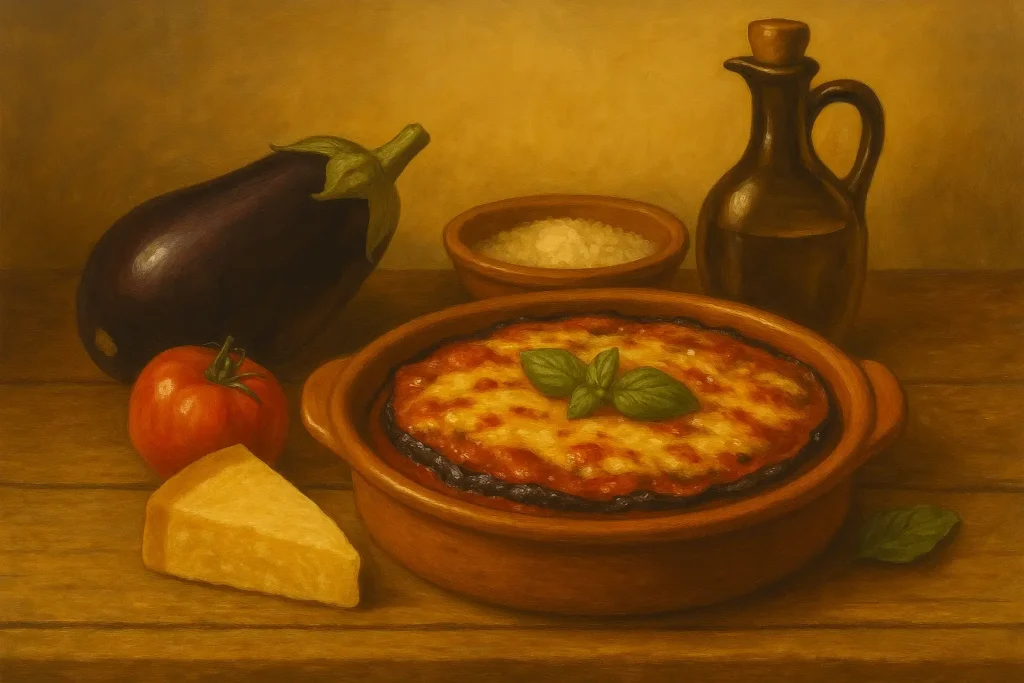
Parmigiana is one of those dishes in which nothing is accidental:
– the eggplant should be fried, never grilled, if you want the full flavor of tradition
– the sauce should be made slowly, with fresh basil
– the mozzarella must be dry, otherwise it ruins the texture
– the grated cheese gives flavor and creates the crust
– and then there’s you, the patience: because parmigiana must be allowed to rest, like all good things.
👩🍳 A Family Rite
Some people prepare it on Saturday for Sunday.
Those who make an extra pan “because it tastes even better tomorrow.”
Those who take it to country lunches, or serve it on St. Joseph’s Day.
Every family has its own version.
Some people add hard-boiled eggs, some make it white, and some even put ham.
But the truth is that parmigiana you don’t argue with it, you love it. As it comes, it comes. And it always comes be
❤️ A Dish That Tastes Like Home
Parmigiana is the kind of dish that you never cook for yourself alone.
It is done for someone. To share. To bring a moment of warmth to the table.
Every bite tells of a season of good tomatoes, a busy kitchen, a noisy Sunday.
And if today you find it in gourmet restaurants in deconstructed, mini, spoon-served versions…
one thing is certain: nothing beats Grandma’s baking dish, pulled out of the oven with a floured apron and a barely-there smile.
🌊 And if you love reinterpretations, don’t miss my contemporary version
did you know that?
👉 The first written traces of parmigiana appear as early as 1837 in the book “Cucina teorico-pratica” by Ippolito Cavalcanti, duke of Buonvicino.
👉 In some families in Campania, they used to prepare it with eggplants floured and dipped in egg, before frying, to make them even softer.
👉 A pinch of sugar is also added to the sauce in many Sicilian recipes to balance the bitterness of the eggplant.
the Contemporary Recipe
This post is also available in: Italiano